
Becoming Hardware Scientists
Creating automated, executable experiments (fuelled by 2am spicy ramen)
Dear SoTA,
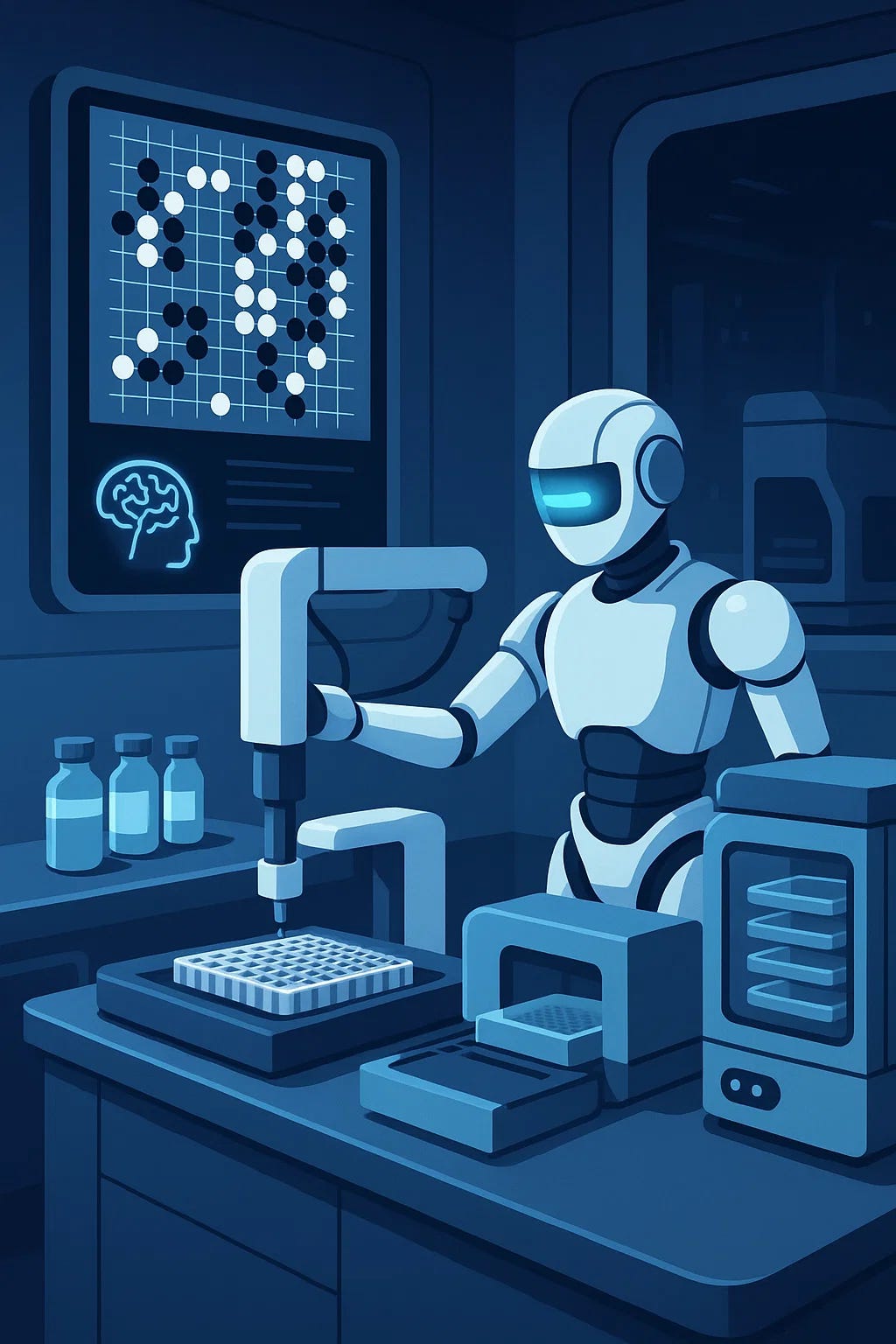
After 3 days of self-play AlphaGo-Zero beat the previously published version of AlphaGo that had beaten Go master Lee Sedol. During training it spent trillions of FLOPS exploring game trees to discover novel strategies, becoming the best Go player the world has ever seen. In that same 3-day period a biologist would be lucky to gather 10 data points.
The great lesson of the last 30 years has been that search and learning multiplied by scale vastly outperform human intuition. As Rich Sutton wrote in the Bitter Lesson: “general methods that leverage computation are ultimately the most effective”. But while ML has benefited from consistent hardware improvements, providing even school children with the ability to train NNs far bigger than what a researcher 50 years ago could even dream of, biologists are yet to see a similar rise in their ability to leverage massive search to generate data. In biology the equivalent unit to FLOPS would be data points from experiments or DATEs, but while some progress has been made in large scale genomics or proteomics, most researchers are still doing work that would be familiar to someone from the 50s; manually moving tiny volumes of liquid between similarly tiny test tubes, and their DATE rate is still correspondingly low.
For biologists to experience a similar increase in capability to ML researchers, there needs to be a consistent increase in available biocompute – the hardware biologists use to perform experiments — coupled with methods like massive search and learning that continue to scale as the amount of biocompute increases. Automated, executable experiments are the obvious answer. Currently, however, the cost of hardware prevents researchers from doing this.
A single Hamilton (as much as $2 million) or Teccan (~$600k) liquid handler costs well beyond the budget of all but the most well resourced labs. Even a more reasonably priced Opentrons Flex (£60k with all the bells and whistles) is pricey and many labs talk about the frustration of buying one and having it sit around unused after a single project. Proprietary software and limited APIs make integration challenging and it isn’t always possible to find a robot capable of the specific task you want to perform. This led us to consider whether we could simply build alternatives to these commercial tools and tailor them precisely to our needs. We quickly realised that we could achieve much of what commercial liquid handlers did at a fraction of the cost.
We had similar realisations when comparing incubator and plate reader costs. This was the motivation behind tackling this topic at SoTA’s Embodied Intelligence Hackathon. As we started preparing for the hackathon, designing what we would build, ordering parts and testing circuits, we were pleased with the results we were getting.
The hackathon itself was a fantastic experience. We enjoyed meeting all the other teams and seeing their work and were impressed by the quality. Powered by the spiciest 2am ramen I have ever eaten and catching a few hours of sleep on a table and in a stairwell, by the time of the demo we had managed to achieve sub millimeter accuracy xy positioning, ~20 microlitre dispensing accuracy, 0.5oC temperature control in our incubator and a custom built SCARA arm able to move plates from the liquid handler work surface into the incubator. We were pleased with the result and very grateful to the judges for choosing us as the overall winners.
Following the hackathon, we achieved similarly convincing results with our plate reader (~1% difference in OD value against commercial equipment) at a cost of around £100.
Now we are upgrading the hardware further and moving on to a second stage, designing arms and conveyers to move plates between different robots in order to build up a real automated lab.
In doing this we are not innovators. We take our inspiration from early chemists, biologists and physicists who had to build their own equipment. Hooke, Newton and Faraday were not just inspired theoreticians. They were skilled craftsmen, glassblowers, lens grinders and metal workers who were able to understand and even extend the limits of the available hardware in order to test novel theories. Sanger, for example, hand-built the gel readers that would allow him to sequence the first human genome. Their building of lab equipment was not separate from their research but instead fundamental to it.
We call this hardware science. Working in this way has already paid dividends.
While working on the plate reader for example we have been exploring the use of different wavelengths of light to measure optical density. While 600nm is a common standard, scattering by cells is still readable up to 820nm and can work well for high density cultures where typical 600nm readings struggle. In addition, by carefully choosing the resistors in our sensing op amp we have been able to tune the sensitivity of the system to precisely match our use case.
In a similar vein, James, while working on the liquid hander, built a scale to calibrate the syringe pump that we have used in place of a pipette. This has the added benefit of allowing us to perform gravimetric measurement of high viscosity liquids that volumetric pipette dispensing typically struggles with.
These machines act as an analogue for scalable compute in ML. Our aim is to create the architecture for biocompute, a network of tools that can, like a GPU, rapidly search a large parameter space. This will involve a combination of general purpose, programmable technologies such as liquid handers, programmable microfluidics, electrowetting panels and incubators, as well as low cost analytical equipment (FTIR, spectrophotometer, microscope, camera), high cost analytical equipment integration (mass spec and HPLC, though we do think both these are overpriced and could be recreated) and custom built tools that can carry out a specific and novel function, such as breaking apart flocs, or tapping a tube three times to dislodge the mixture inside.
Cloud labs have shown the difficulty of providing the equipment to do any arbitrary experiment. Therefore we are starting with microbial growth responses to stimuli as an ideal, high parameter, easily measurable area. We aim to produce models able to predict precisely the effect of oxygen, inhibitors, sugars, stressors and other stimuli on prokaryotes to accelerate industrial biotechnology before branching out into other areas of biology.
We would encourage any people interested in this work to reach out to us, if they think they have a use for the system or would like to hear more about our approach.
Many thanks again to SoTA for organising the hackathon and to the judges.
Yours,
This is excellent