
Chemputation: Chemistry Programming & Molecular Discovery
From computation to chemputation, chemistry is a Universal Machine
Dear SoTA,
When I think about Alan Turing’s seminal work on computation, I am struck by the simplicity and power of his insight. This insight is that a Turing machine can perform any algorithmically definable task, given sufficient time and memory. This idea laid the foundation for modern computing, where universal machines are defined not by hardware, but by the software that drives them. Chemistry, however, has resisted this kind of abstraction. In my own career, I have seen how synthetic practice remains largely artisanal. Each target molecule requires a unique set of operations, bespoke reaction conditions, and specialist expertise. It is as though chemistry is still in the age of the abacus, powerful in its way, but fundamentally limited in scope or reach. Chemistry needs to make the jump to universality.
That is why I developed the concept of chemputation, which extends Turing’s logic into the physical and molecular domain. A Chemputer is not just an automation tool but a Chemical Synthesis Turing Machine (CSTM), capable of making any stable, isolable molecule. In this framework, reagents become the “data,” reaction conditions provide control flow, and hardware modules embody the chemical equivalent of operation codes. A “chempiler” translates abstract chemical code, what we call χDL (chi-DL), into an executable program that can run on any compatible hardware, see Figure 1.
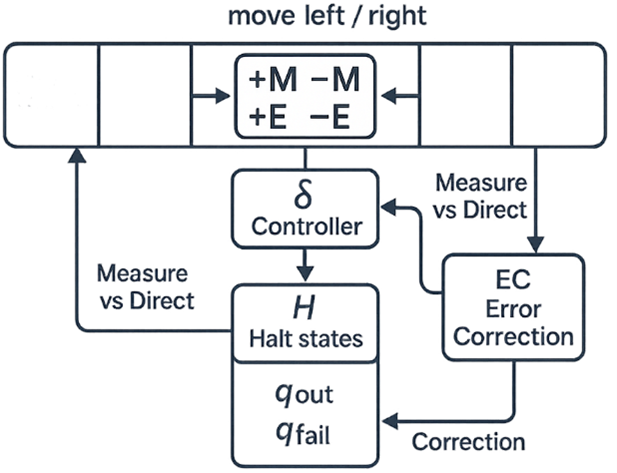
Figure 1. A simplified schematic of the Chemical Turing Synthesis Machine (CTSM). The tape has a head that can add matter (+M), subtract matter (-M), add energy (+E), subtract energy (-E) and a controller that runs the code checks for errors, measures the state of the tape, and then halts to give an output or to a failure mode.
For me, this represents a decisive shift where chemistry elevated to the same status as general computation. Just as the programmable computer liberated us from hardware-specific calculators, chemputation frees chemistry from the limitations of reaction-specific machines. With this universal approach, I can now encode the construction of molecules into modular, reusable and universally executable code. That is molecular assembly code can be “chempiled” and run, much like software programs.
Why Chemistry Must Become Digital
Despite the impressive progress in laboratory automation most systems I encounter remain hardware-bound and the hardware is fragile. Some devices can perform specific reactions with precision, but they lack universality. For example, solid-phase peptide and DNA synthesizers each excel in their niches but none can be reprogrammed to execute arbitrary transformations. Without an abstraction layer, every new target requires new hardware, new engineering and often new teams of chemists. I believe the need for a universal programming language for chemistry is clear. Chemical synthesis must evolve into a programmable system, complete with instructions, loops, conditional operations, and error handling. This is what chemputation provides. It is not just an abstraction but a framework that allows reproducibility, scalability and shareability of synthesis across the globe.
To explore molecular complexity, I developed a new framework to explore the assembly of complex molecules called assembly theory. Briefly, assembly theory has myriad of uses but for chemical synthesis I realized that it was possible to use the assembly index of a molecule, that is the minimal steps needed to build a molecule, to help bound the physical constraints on the chemputation of that molecule.
This is because this measure makes it possible to calculate the resources, fidelity, and error correction required for synthesis. Once chemical processes are encoded in χDL, they can be executed on Chemputers anywhere in the world. This creates reproducibility at scale, validation across laboratories, and the possibility of a global repository of executable chemistry. For me, this goes far beyond traditional paper-based publishing. It points to a future where experimental chemistry can be instantly shared, run, and verified on demand whether across the corridor, or across continents by making a GitHub for chemical programmes.
Unlocking Molecular Complexity
One of the aspects that excites me most about chemputation is its potential to expand the accessible frontier of chemical space. In traditional laboratories, the complexity of synthesis grows exponentially with the length of a route. Each additional step increases the chance of failure and errors propagate rapidly making many ambitious targets impractical. Here, assembly theory provides a rigorous way to frame the challenge.
The assembly index defines how much causal information is required to construct a molecule. As the index rises, so too does the need for precision and reliability at each step. Without correction, flawless copies dwindle exponentially. This is where chemputation shows its strength. By embedding error correction (EC), integrating spectroscopy, chromatography and mass spectrometry into real-time closed feedback loops, I can detect deviations and adjust the process dynamically. Minor fluctuations can be tuned on the fly. Major divergences can be rolled back to a prior state. With such resilience built in. We are now able to synthesize molecules of far greater complexity than before. Chemputation does more than automate, it allows us to push into vast, previously inaccessible regions of chemical space. This means the practical discovery of novel drugs, advanced materials, and catalysts that traditional methods struggle to reach. Where synthetic chemistry once struggled to go deep into chemical space due to manual chemistry, chemputation offers a path to scalable molecular creativity, analogous to Moore’s law for semiconductors but applied to molecules.
Chemify and the Era of Quantum Chemputation
Building on this vision, I started Chemify in 2022 to pioneer the translation of chemputation into an industrial and scientific platform. At Chemify, our mission is to build a system where molecular design, synthesis, and verification are seamlessly integrated and chemputation becomes scalable. To achieve this, we are combining chemputation with quantum chemical simulations, to give what I call Quantum Chemputation. This allows us to perform inverse design, starting from a desired property or function, algorithms explore chemical space to propose candidate molecules. These are automatically compiled into χDL code, executed on robots capable of chemputation, and validated with embedded sensors. The feedback refines both our predictive models and our synthetic strategies, creating a virtuous cycle of discovery, design, and manufacture.
In medicine, this means we can generate and validate new drug candidates faster, with higher reliability and lower cost. In technology, it means breakthroughs in photovoltaics, battery electrolytes, and advanced polymers. Our Chemifarm in Glasgow, see Figure 2, a fully automated facility already operational, demonstrates the integration of AI design engines, modular robotics, and large-scale synthesis.
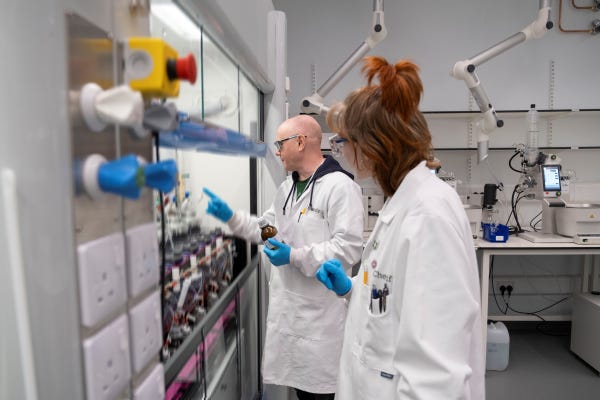
Figure 2: Inside Chemify’s 12,500 sq ft Chemifarm which opened in Glasgow in June 2025.
My long-term vision is even bolder, to create a searchable, provable atlas of chemical space, where every molecule is not just theoretically describable but practically synthesizable. By digitizing chemistry at its core, I aim to democratize access to molecules, transforming them into programmable resources for innovation across science, medicine, and technology. Today, Chemify’s ‘Infinite-library’ has more than 1035 potential synthesizable molecules. If there was enough resource to make just 1 trillionth of a gram of each of these molecules, they would all collapse under their gravity to form a black hole.
Conclusion
For me, chemputation is not just a new tool, it is a radical rethinking of what chemistry is and can be. By treating molecules as programmable constructs, we gain universality, reproducibility, and scalability. The urgency is clear. Without digital chemistry, discovery remains constrained by inefficiency and fragility. With chemputation, we unlock complexity on a scale never before possible. Through Chemify, we are working to make this transformation real uniting theory, automation, and Quantum Chemputation into a single framework. I believe the future of chemistry lies in its digitization, and with chemputation, we are taking the decisive step toward programming the molecular world.
Note: this was written based on our work preprinted here.
Yours,
Hello there, I quite enjoy your posts friend, so I thought I’d drop a comment, and introduce myself with an article you may like:
https://substack.com/@jordannuttall/note/p-176263118?r=4f55i2&utm_medium=ios&utm_source=notes-share-action
Are there failsafe mechanisms that would determine the safety of new molecules? Do you envision this as a way to eventually assist in mapping the ever-fluctuating epigenome?