
Creating GNSS Redundancy with Quantum
Aquark is driving cold-atom quantum breakthroughs and deploying with the Royal Navy

Dear SoTA,
The Global Navigation Satellite System (GNSS), is a cornerstone of technological advancement and a staple of daily life. We rely on it without sparing it a thought. It offers numerous benefits and enables trillions in economic activity on a global scale. But, over the last several decades, the once-small risks of GNSS outage and disruption has escalated into critical vulnerabilities in need of mitigation across various sectors.
This paradox of progress calls for innovative solutions - and quantum has the answer. Building quantum solutions requires interdisciplinary and in-depth expertise in physics, engineering, and photonics.
Aquark knows that collaborators and quantum talent are essential not only to support GNSS resilience and the enhancement of other methods of technological advancement, but also to sustain the quantum technology ecosystem that we are part of.
Positioning, navigation, and timing (PNT) data enables everything from the maps on our smartphones, to the timestamping of our financial transactions, and the synchronisation of our energy grids.
Globally, PNT services are provided by the collective GNSS and are operationally deployed through many systems including GPS, GLONASS, Galileo and BeiDou.
However, the Achilles Heel of PNT is GNSS outage – it’s a single point of failure for critical systems dependent on precise timing. This is not a new problem.
Unfortunately, the ubiquity of PNT usage, combined with current geopolitical tensions, sees deliberate GNSS disruption becoming an everyday problem.
The UK government has estimated that a seven-day GNSS outage could cost the economy a staggering £7.6 billion. With so many applications relying on GNSS for timing, the consequences of our signals being disrupted could be catastrophic.
GNSS faces three major challenges: Space weather events such as solar flares (electromagnetic noise, damage to or even disabling of satellites); Systemic limitations (legacy architecture, lack of redundancy); and Deliberate interference (jamming, spoofing) by malicious actors, which is increasingly common today.
Already GNSS functionality is degraded in the polar regions due to the positioning of the satellites and in urban canyons where signals are blocked or bounced by high buildings. Once we move underground or underwater its functionality is often totally lost.
These vulnerabilities, compounded by the importance of GNSS, are some of the immediate challenges we set out to address when I co-founded Aquark Technologies.
If GNSS is disrupted, ground-based atomic clocks provide reliable holdover, delivering a stable timing signal until GNSS access is restored.
To achieve the highest level of accuracy, atomic clocks must reference a precisely defined frequency, measure it with exceptional precision, and maintain that measurement undisturbed over long periods. Some of the most advanced systems use lasers to trap and cool atoms to temperatures near absolute zero. This process minimizes atomic motion, allowing the natural frequency of atomic energy transitions to be measured with unparalleled accuracy.
The main challenge for atomic clocks today is that conventional cold-atom systems, such as magneto-optical traps (MOTs), remain expensive and impractical outside laboratory environments.
Our proprietary ‘Super-Molasses Trap’ (SMT) is an evolution of conventional laser atom traps. It uses counter-propagating laser beams to slow down atoms, reducing their thermal motion in a manner similar to an MOT, but without the need for an assisting magnetic field. This means our unconventional SMT creates the coldest places in the universe – cooler than the cosmic microwave background – in a smaller and more energy efficient way than ever before (see footnote).
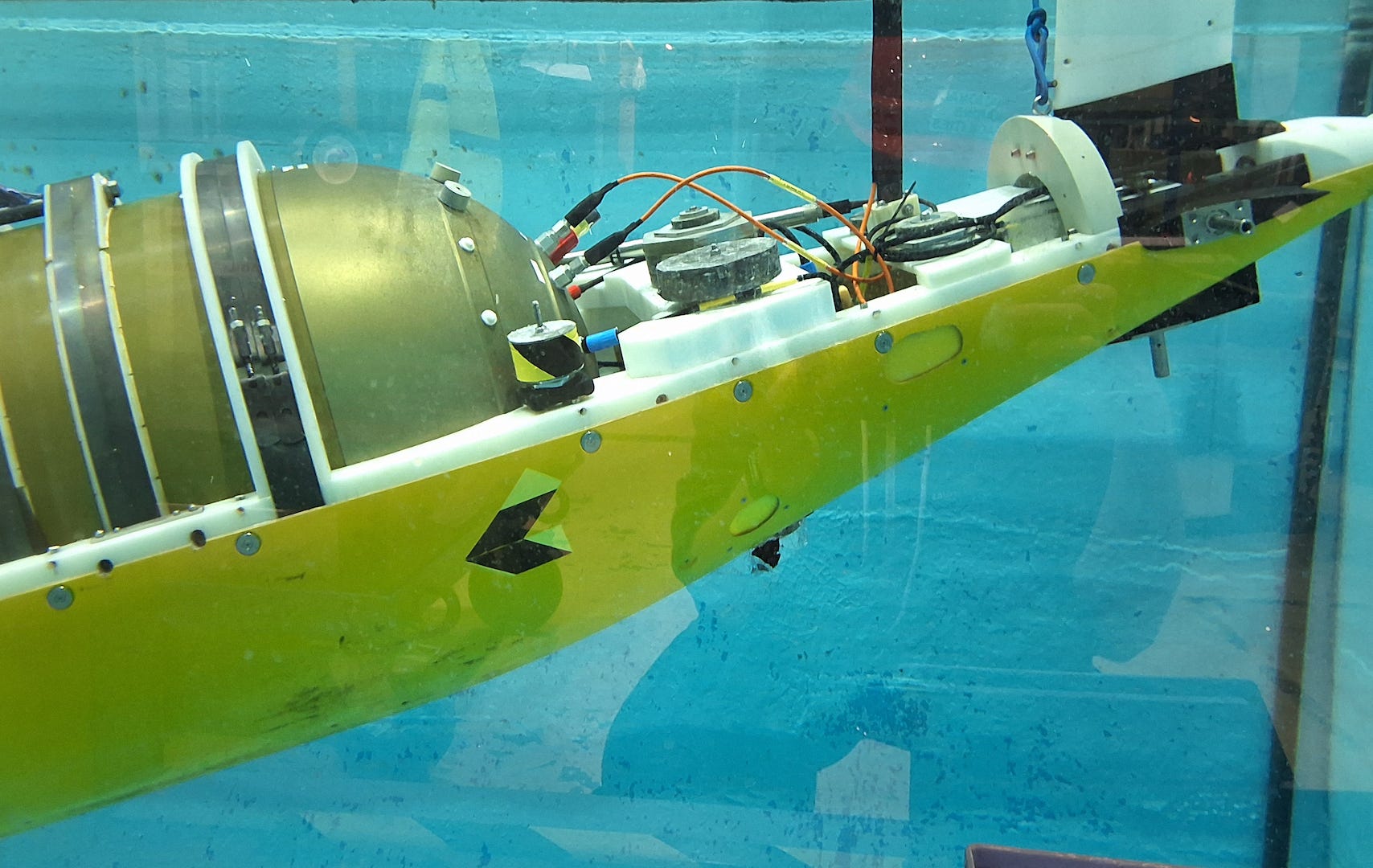
Working with cold atoms is our bread and butter, but we’re also applying advanced micro-fabrication techniques and photonics to enhance robustness and boost reliability. Our key achievements to date are AQuest and AQlock:
AQuest: The world’s smallest self-contained cold-atom system
Our efforts to miniaturise and modularise system components led to the launch of AQuest in November 2024. This is the engine of our sensors.
Compared to typical, conventional MOT systems, AQuest’s SMT has lower power consumption, greater stability and robustness to challenging environments. Its compact, modular design retains performance with nearly 50% fewer components, making it suitable for scalable production. These benefits combine to break the historic cost barriers of cold atom traps.
AQlock: The UK’s first commercial cold-atom-based atomic clock
In March 2025, with a £3.4 million Small Business Research Initiative (SBRI) contract from Innovate UK, we completed AQlock, the UK’s first industrially designed and built commercial cold atom-based atomic clock, with AQuest at its core.
AQlock can measure the natural quantum ‘tick’ of atoms for long, uninterrupted periods. This capability can be used to automatically and precisely correct a classical clock as needed, reducing its long-term drift without requiring any correction to the timing signals that are usually provided by GNSS.
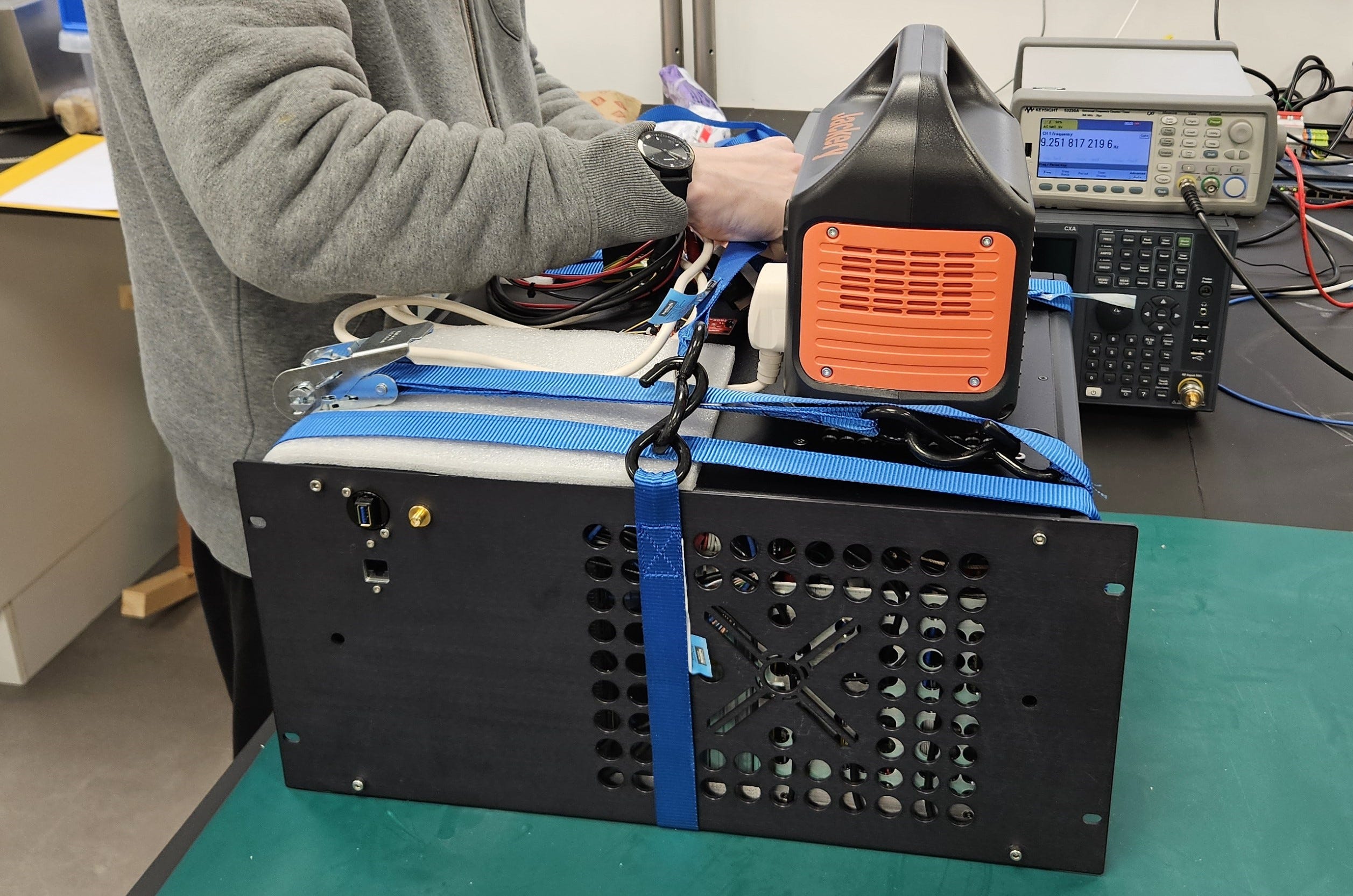
Building effective quantum sensors is only half the battle. To be commercially viable, the technology must be deployment-ready in harsh environments.
We were proud to be among the first 44 startups selected for NATO’s inaugural Defence Innovation Accelerator for the North Atlantic (DIANA) programme, which identifies and accelerates dual-use technologies with civilian and military applications. Successful collaboration in Phase I focused on solving critical defence and security challenges. This led to our selection for Phase II of the acceleration programme, helping us test our technology working in demanding underwater conditions.
In a Royal Navy sea trial aboard HMS Pursuer, we deployed the first AQlock, which operated continuously, maintaining precise timing even in rough conditions without GNSS.
Announced in November 2025, work on the second-generation AQlock is already underway with a contract from Innovate UK to facilitate product development and trials with a global telecoms company. The project is grounded in engineering refinement as we move to production. We are working towards delivering more resilient telecommunications networks for millions of people across Europe.
Our mission requires interdisciplinary collaboration with enthusiastic scientists, engineers, researchers and end users to drive technical advancements.
The technology we are building is complex, and our mission is not just to build systems that will revolutionise industries, but to help develop and sustain the quantum tech ecosystem.
If you are an engineer, technologist, or just interested in taking your first step into the quantum industry, reach out.
Yours sincerely,
Co-founder of Aquark Technologies Ltd
[Footnote]
The cosmic microwave background is 2.725 K, so any atomic ensemble colder than this must be artificially created, making these man-made states among the coldest in the universe. Researchers have achieved even lower temperatures using advanced techniques, but such methods require highly complex equipment, limiting their practicality outside the labor now.
Brilliant execution on the SMT architecture. Ditching the magnetic field dependecy while maintaining trap performance is non-trivial, and the 50% component reduction is huge for manufacturabilty. The HMS Pursuer validation in rough seas feels like the actuall proof point that cold-atom systems can leave the lab.